The Catholic Church honors St. Bernardine of Siena on May 20. A Franciscan friar and preacher, St. Bernardine is known as “the Apostle of Italy” for his efforts to revive the country’s Catholic faith during the 15th century.
Bernardine Albizeschi was born to upper-class parents in the Italian republic of Siena during 1380. Misfortune soon entered the boy’s life when he lost his mother at age three and his father four years later. His aunt Diana cared for him afterward, and taught him to seek consolation and security by trusting in God.
He was the greatest preacher of his time, journeying across Italy, calming strife-torn cities, attacking the paganism he found rampant, attracting crowds of 30,000, following Saint Francis of Assisi’s admonition to preach about “vice and virtue, punishment and glory.”
When he was 20, the plague was at its height in his hometown of Siena. Sometimes as many as 20 people died in one day at the hospital. Bernardine offered to run the hospital and, with the help of other young men, nursed patients there for four months. Although the plague did not infect him, the exhausting work left him weak and he contracted a different sickness that kept him in bed for four months.
After recovering, he spent over a year caring for his aunt Bartholomaea before her death. Then the 22-year-old Bernardine moved to a small house outside the city, where he began to discern God’s will for his future through prayer and fasting.
At 22, he entered the Franciscan Order and was ordained two years later. For almost a dozen years he lived in solitude and prayer, but his gifts ultimately caused him to be sent to preach. He always traveled on foot, sometimes speaking for hours in one place, then doing the same in another town.
Bernardine’s personal devotion to God, which amazed even the strict Franciscans, made his preaching extremely effective. He moved his hearers to abandon their vices, turn back to God, and make peace with one another. He promoted devotion to the name of Jesus as a simple and effective means of recalling God’s love at all times.
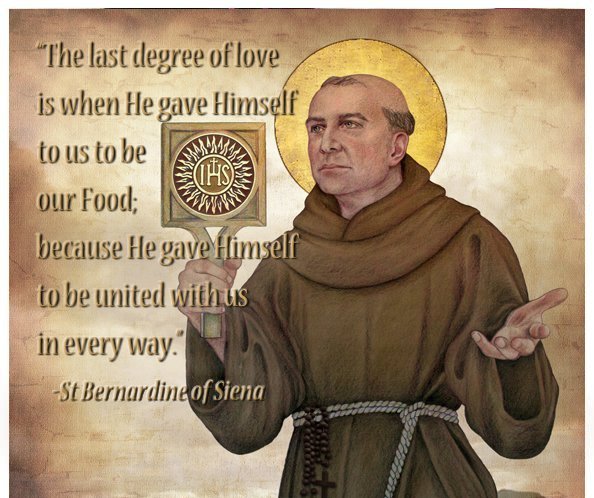
Especially known for his devotion to the Holy Name of Jesus, Bernardine devised a symbol—IHS, the first three letters of the name of Jesus in Greek—in Gothic letters on a blazing sun. The devotion spread, and the symbol began to appear in churches, homes and public buildings. Opposition arose from those who thought it a dangerous innovation.
Later in his life, Bernardine served for five years as the Vicar General for his Franciscan order, and revived the practice of its strict rule of life. Then in 1444, forty years after he first entered religious life, Bernardine became sick while traveling. He continued to preach, but soon lost his strength and his voice.
St. Bernardine of Siena died on May 20, 1444. Only six years later, in 1450, Pope Nicholas V canonized him as a saint.
Related videos on the saint:-

 The POSITIVE Catholic