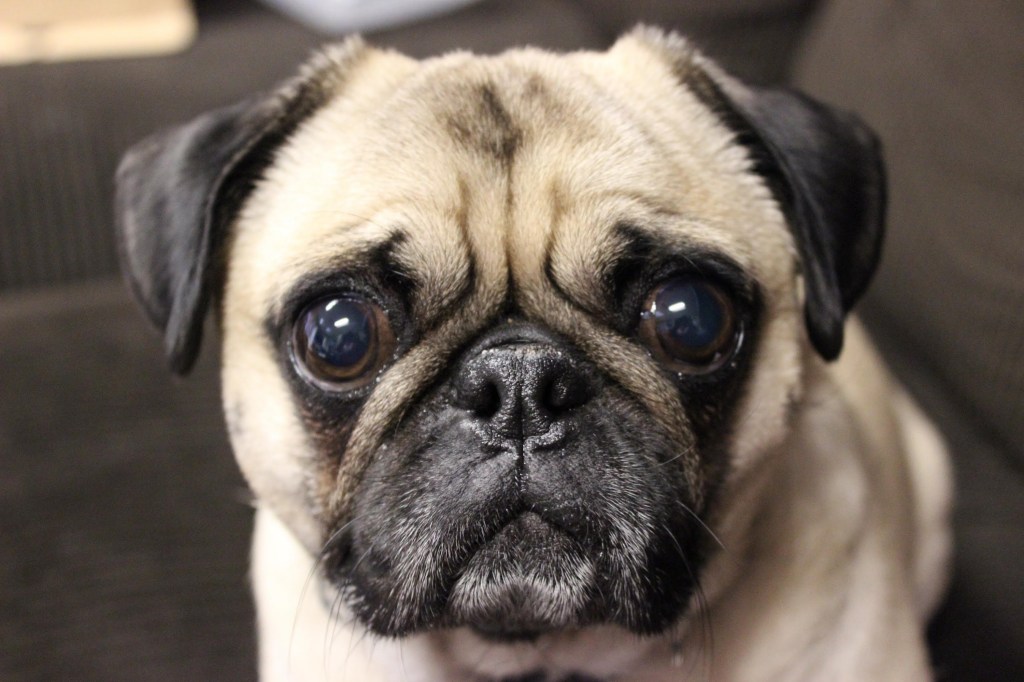
Pugs often are described as a lot of dog in a small space. These sturdy, compact dogs are a part of the American Kennel Club’s Toy group, and are known as the clowns of the canine world because they have a great sense of humour and like to show off. Originally bred to be a lap dog, the Pug thrives on human companionship.
A Little History
Pugs originated in China, dating back to the Han dynasty (B.C. 206 to A.D. 200). Some historians believe they are related to the Tibetan Mastiff. They were prized by the Emperors of China and lived in luxurious accommodations, sometimes even being guarded by soldiers.
Pugs are one of three types of short-nosed dogs that are known to have been bred by the Chinese: the Lion dog, the Pekingese, and the Lo-sze, which was the ancient Pug. Some think that the famous “Foo Dogs” of China are representations of the ancient Pug. Evidence of Pug-like dogs has been found in ancient Tibet and Japan.
In the latter 1500s and early 1600s, China began trading with European countries. Reportedly, the first Pugs brought to Europe came with the Dutch traders, who named the breed Mopshond, a name still used today.
Pugs quickly became favourites of royal households throughout Europe, and even played a role in the history of many of these families. In Holland, the Pug became the official dog of the House of Orange after a Pug reportedly saved the life of William, Prince of Orange, by giving him a warning that the Spaniards were approaching in 1572. When William of Orange (later called William III) went to England in 1688 with his wife, Mary II, to take the throne from James II, they brought their Pugs with them.
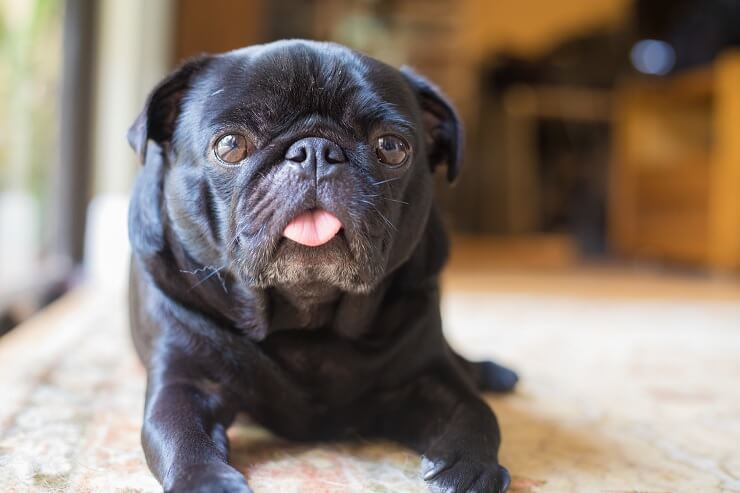
It is known that black pugs existed in the 1700s because the famous artist, William Hogarth, was a Pug enthusiast. He portrayed a black Pug and many others in his famous paintings. In 1785, Goya also portrayed Pugs in his paintings.
As the Pug’s popularity spread throughout Europe, it was often known by different names in different countries. In France, it was called Carlin; in Spain Dogullo; in Germany Mops; and in Italy, Caganlino.
Marie Antoinette had a Pug named Mops before she married Louis XVI at the age of 15. Another famous Frenchwoman, Josephine Bonaparte, had a Pug named Fortune. Before she married Napoleon Bonaparte, she was confined at Les Carmes prison. Since her beloved Pug was the only “visitor” she was allowed, she would conceal messages in his collar to take to her family.
In the early 1800s, Pugs were standardized as a breed with two lines becoming dominant in England. One line was called the Morrison line and, reportedly, was founded upon the royal dogs of Queen Charlotte, wife of George III. The other line was developed by Lord and Lady Willoughby d’Eresby, and was founded on dogs imported from Russia or Hungary.
Meanwhile, in China, Pugs continued to be bred by the royal families. When the British overran the Chinese Imperial Palace in 1860, they
discovered several Pugs, and brought some of the little dogs back to England with them.
Pugs became very popular during the Victorian era and were featured in many paintings, postcards, and figurines of the period.
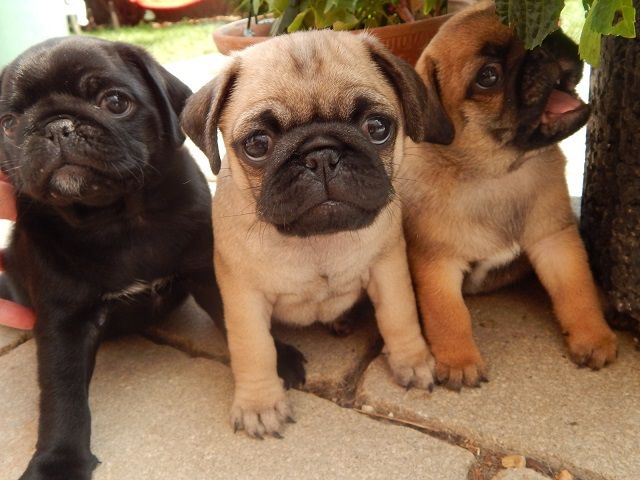
Queen Victoria had many Pugs, and also bred them. The queen preferred apricot-fawn Pugs, whereas another Pug fancier, Lady Brassey, made black Pugs fashionable after she brought some back from China in 1886.
Pugs were introduced to the United States after the Civil War, and the breed was recognized by the American Kennel Club in 1885. At first, Pugs were very popular, but by the turn of the century, interest in the breed waned. A few dedicated breeders kept breeding and, after some years, the breed regained popularity. Founded in 1931, the Pug Dog Club of America was also recognized by the AKC that year.
Characteristics
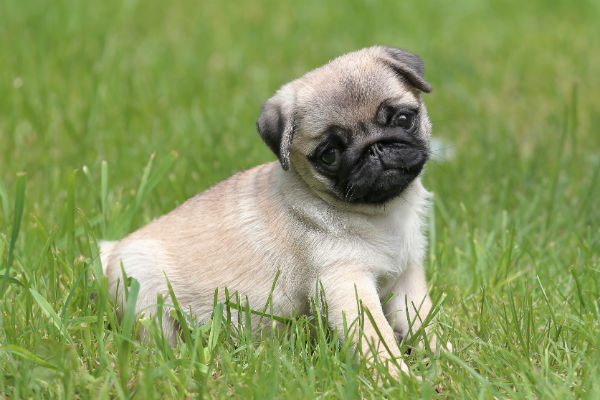
The Pug’s comical face, with deep wrinkles around big, dark eyes and a flat round face, can’t help but make you smile. It is believed that the Pug’s name comes from the Latin word for “fist” because his face resembles a human fist.
Pugs are clowns at heart, but they carry themselves with dignity. Pugs are playful dogs, ready and able for games, but they are also lovers, and must be close to their humans. Pugs love to be the center of attention, and are heartsick if ignored.
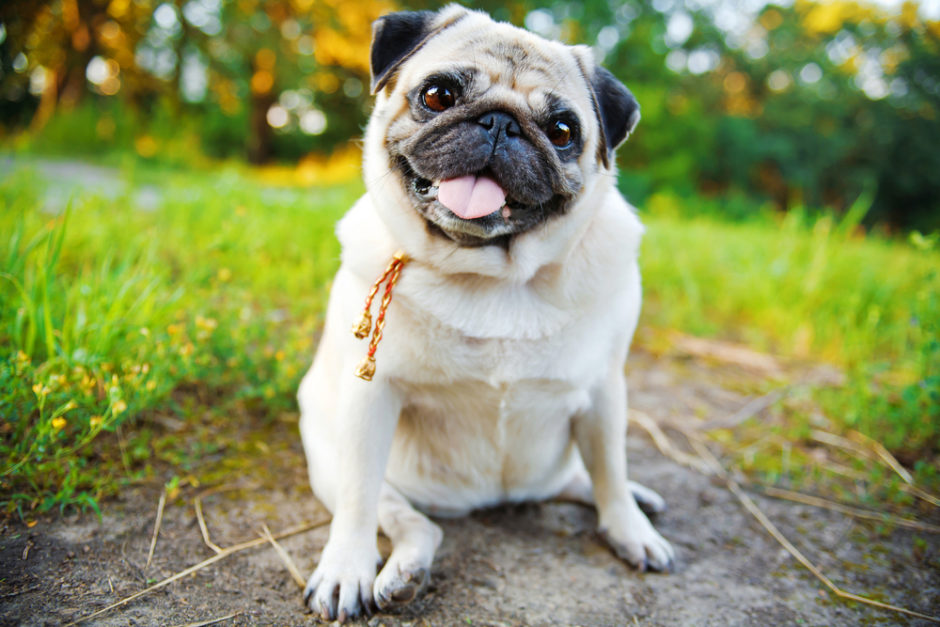
The moles on a Pug’s cheeks are called “beauty spots.” His muzzle or mask is black, with a clearly defined “thumb mark” on the forehead and a black trace down the center of the back. His ears are smooth, black and velvety. He has a characteristic undershot jaw (the lower teeth extend slightly beyond the upper teeth) and a tightly curled tail.
While Pugs can be good watchdogs, they aren’t inclined to be “yappy,” something your neighbours will appreciate. If trained and well-socialized, they get along well with other animals and children. Because they are a small, quiet breed and are relatively inactive when indoors, they are a good choice for apartment dwellers. Due to the flat shape of the Pug’s face, he does not do well in extremely hot or cold weather, and should be kept indoors.
Pugs have a short, double coat, and are known for shedding profusely. If you live with a Pug, it’s a good idea to invest in a quality vacuum cleaner.
Personality
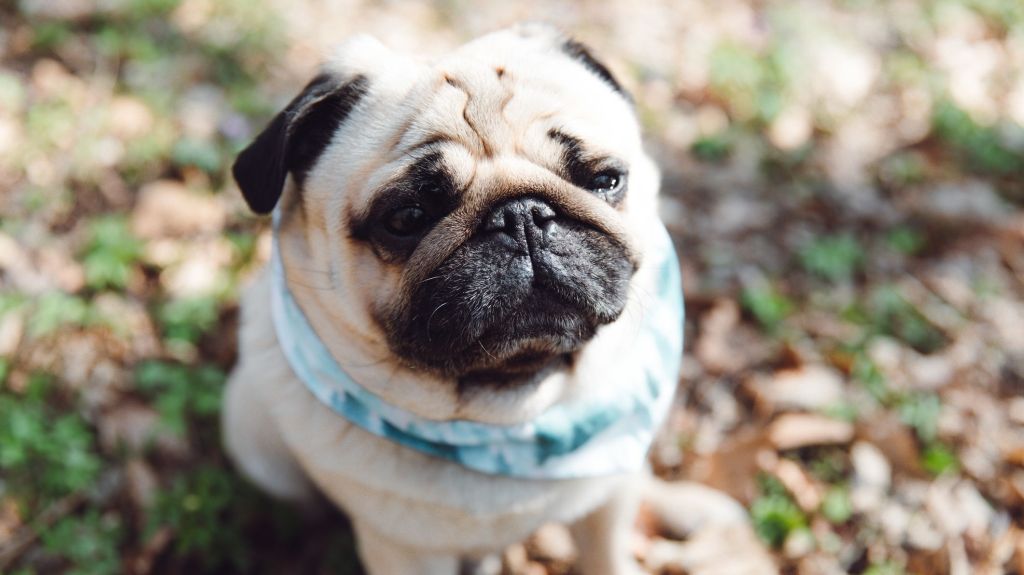
Don’t expect a Pug to hunt, guard or retrieve. Pugs were bred to be companions, and that’s exactly what they do best. The Pug craves affection — and your lap — and is very unhappy if his devotion isn’t reciprocated.
He tends to be a sedentary dog, content to sit in your lap as you read a book or watch a movie. This doesn’t mean the Pug is a stick-in-the-mud. Au contraire. He is a playful, comical dog that enjoys living it up, and delights his owner with silly antics.
Like every dog, the Pug needs early socialization — exposure to many different people, sights, sounds, and experiences — when they’re young. Socialization helps ensure that your Pug puppy grows up to be a well-rounded dog.
Enrolling him in a puppy kindergarten class is a great start. Inviting visitors over regularly, and taking him to busy parks, stores that allow dogs, and on leisurely strolls to meet neighbours will also help him polish his social skills.

 The POSITIVE Catholic