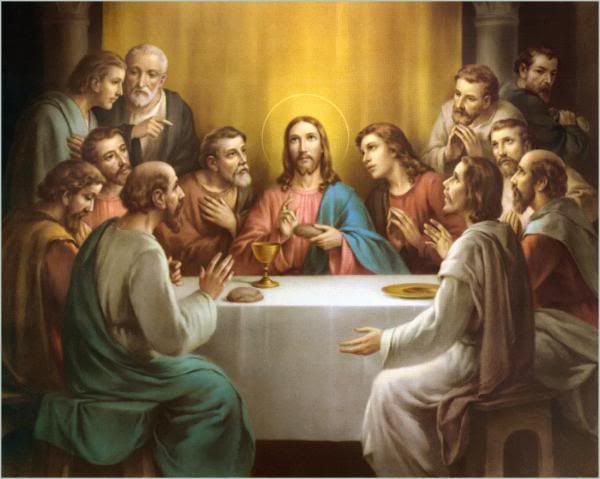
Fifth Luminous Mystery : The Institution of the Eucharist
In the Old Testament Moses reminds the people how God looked after them during the forty years in the desert. When we know that we are in a desert, we realize that we have nothing to rely on but God. We no longer live on bread alone but on the life-giving word that comes from the mouth of God. Our existence in this world really is a desert, but we don’t always realize it. What do we try to base our lives upon? How many silly and frivolous things we are fixated with! Jesus comes to us in the form of bread to show us that he is as essential to us as physical food is for our existence. Let us ask ourselves “What is really essential for me to live an authentic life?” We must reflect on our lives and recognize that much of what we base our identities upon is non-essential. Those things are an empty desert that fail to nourish us in a permanent way. Jesus is our true bread that gives us life of a genuine nature. When we look to the Eucharist, we see the same loving, provident God that looked after the people of Israel during those forty years. He looks after us too in the desert of our existence, this God who becomes bread for his people and nourishes us to eternal life.
The theme of the Gospel of the loaves and the fishes is the problem of how to satisfy the hunger of the crowd. What does humanity need if its hunger is to be satiated? It is interesting to note that this basic need of humanity to eat and drink has a central place in the liturgy and in the sacraments. We have been created by God with this necessity of having to eat, with the requirement for external sustenance in order to survive. Hunger was the first temptation of Christ in the desert, and it had a central place in the first sin recorded in Scripture. Adam and Eve ate that which was not supposed to be eaten. They sought to satisfy their inner anxiety with a form of sustenance that was inappropriate. This is a perennial theme of the human being: our anxiety to find a source of sustenance for our lives. We have a constant, burning, worry about where we will obtain what we need for life. This necessity gives rise to a terrible anguish within humanity, but it is ultimately a question of relationship with God. In the Gospel of Matthew, Jesus exhorts us not to worry about what we will eat, drink or wear; it is the pagans who worry about these things. God has given me life. Do I continue to rely on him for the source of my life, or should I take things completely in my own hands and look after that business myself? The Eucharist calls on us to abandon ourselves completely to the providential grace of God.

 The POSITIVE Catholic