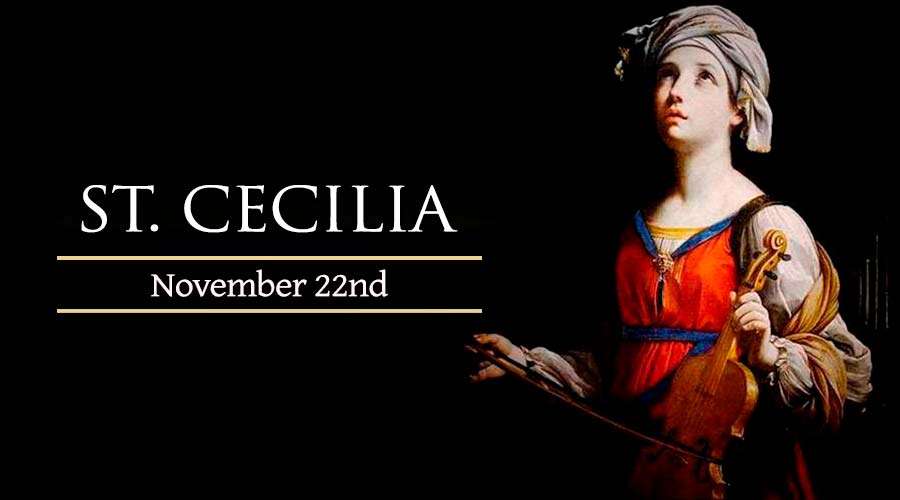
St. Cecilia’s family was one of the principle families of Rome. According to the cultural custom of the time, Cecilia’s family betrothed her to a pagan nobleman named Valerian despite St. Cecelia’s consecration to God. On their wedding night, Cecilia told Valerian that she had sworn to remain a virgin before God and that an angel guarded her body, protecting her virginity from violation. She told Valerian that he would be able to see this angel if he went to the third milestone along the Via Appia and was baptized by Pope Urban I. Valerian went to the milestone as Cecilia had instructed, and there was baptized. She later converted his brother as well.
During that era, it was forbidden for anyone to bury the bodies of Christians, so newly-baptized Valerian and his brother dedicated themselves to burying the bodies of all the Christians they found. For this, they were arrested and brought before a judge who ordered them to worship the Roman god Jupiter, and were martyred when they refused to deny their Christian faith. The police then came for Cecilia and strongly advised her to renounce her faith. In reply, she told them that she would prefer to die than to denounce the true faith. According to legend, upon hearing her response, they brought her to a large oven with the intention of suffocating her with the hot and toxic gasses it emitted. However, instead of choking, Cecilia began to sing. Infuriated, her persecutors attempted to behead her, but after three strokes of the sword, Cecilia was still alive and her head was not severed. The soldiers then left her covered in blood in her own home, where she remained for three days before she died.
The church Santa Cecilia in Trastevere was built on the site of the house where she lived. St. Cecelia is known for “singing in her heart to the Lord” upon her wedding day, despite her consecration to God. She is the patron Saint of musicians and poets because of this sentiment and her alleged singing within the oven during her martyrdom. Her fortitude may inspire the modern Catholic in the trials of life and inspire one to find God within music.
REFLECTION
Look up at the night sky. Remember we live on a small planet spinning around our yellow sun. It sits on a spiral arm of our +150,000 light-year-wide Milky Way galaxy. Our galactic home holds an estimated 200 bn other stars. Recent calculations place the number of galaxies in the known universe at two trillion. Each of these could contain billions of stars, together totalling more than all the grains of sand on the earth. And each star likely hosts a planetary system. The sheer vastness of creation staggers the mind. Yet this presents just the tiniest inkling of the majesty of God. Today’s feast, Our Lord Jesus Christ, King of the Universe, ends our liturgical year. From Ezekiel, through Paul to Matthew, Jesus is characterized as king and shepherd, glorious and humble at the same time. While today these regal and agrarian images seem distant, perhaps even alienating, they are certainly far less challenging than the cosmic reality that science opens our eyes to. Whatever images we choose for our triune deity – the Alpha and Omega, the prime mover of all creation – God remains the centre of our cosmic story. And the grandeur of the universe is linked directly to how we behave towards one another. “Just as you did it to one of the least brothers and sisters of mine, you did to me.”.

 The POSITIVE Catholic