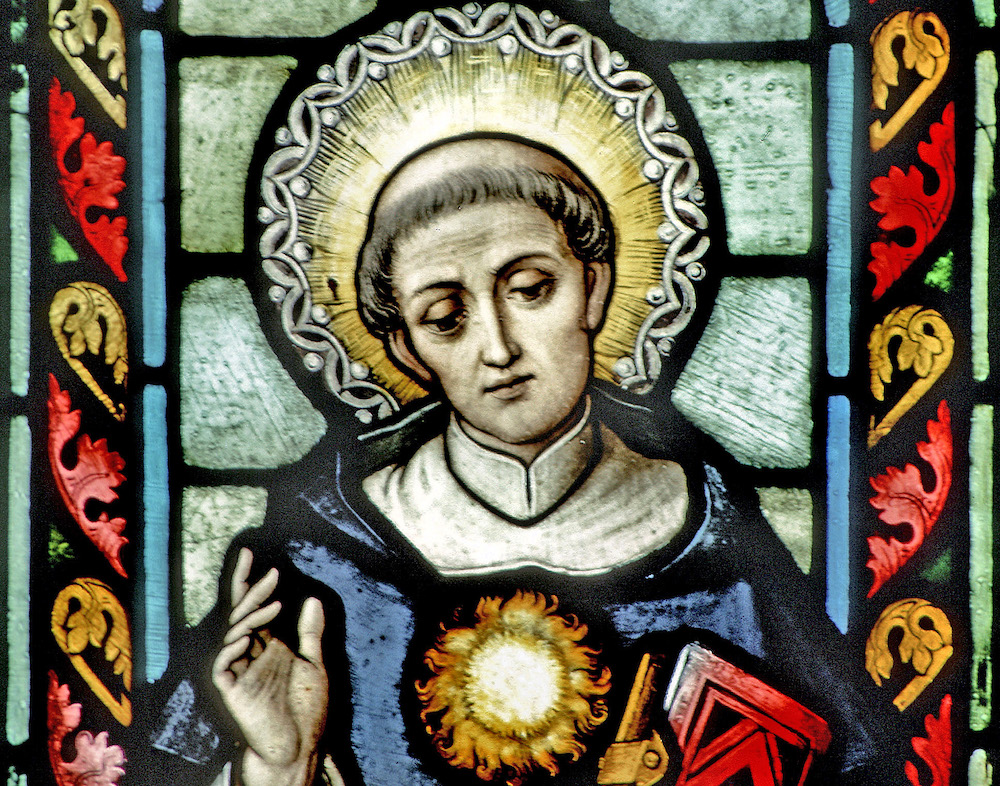
Saint Thomas Aquinas
Counted among the top ten greatest minds ever, by universal consent, Thomas Aquinas is the preeminent spokesman of the Catholic tradition of reason and of divine revelation. Born 1225 at Roccasecca, Italy, at five Thomas was given to the Benedictine monastery at Monte Cassino in his parents’ hopes that he would choose that way of life and eventually become abbot. In 1239, he was sent to Naples to complete his studies. It was here that he was first attracted to Aristotle’s philosophy. By 1243, Thomas abandoned his family’s plans for him and joined the Dominicans, much to his mother’s dismay. On her order, Thomas was captured by his brother and kept at home for over a year. Once free, he went to Paris and then to Cologne, where he finished his studies with Albert the Great. He held two professorships at Paris and lived at the court of Pope Urban IV. His greatest contribution to the Catholic Church is his writings. He stopped work on his Catholic theology after celebrating Mass on 6 December 1273. He died March 7, 1274.
REFLECTION FOR THE DAY
They will receive blessing from the LORD… Psalm 24:5
Today is the feast of St. Thomas Aquinas, the greatest of scholastic theologians. His voluminous writings still have a major impact on theology today. Shortly before his death in 1274, he had a mystical vision that silenced his great pen. When asked to continue writing, he responded, “I cannot, for everything I have written seems to me like straw.” Knowing the truths of our faith is important. We should read and study these often. But the “taste” of a drop of divinity surpasses it all. In love, we become one with our beloved God, a union that surpasses all description. St. Thomas had many great intellectual gifts that he generously shared. God’s greatest gift to him was a direct experience of the divine. It silenced his pen and opened him to the fullness of Love itself. Father in heaven, may we, like St. Thomas, taste your infinite love. May we abandon ourselves to you and thus possess you forever.

 The POSITIVE Catholic