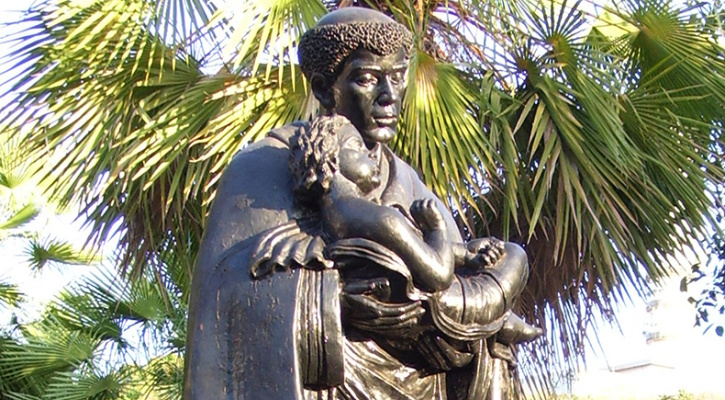
Saint Benedict the African’s Story
Benedict held important posts in the Franciscan Order and gracefully adjusted to other work when his terms of office were up.
His parents were slaves brought from Africa to Messina, Sicily. Freed at 18, Benedict did farm work for a wage and soon saved enough to buy a pair of oxen. He was very proud of those animals. In time, he joined a group of hermits around Palermo and was eventually recognized as their leader. Because these hermits followed the Rule of Saint Francis, Pope Pius IV ordered them to join the First Order.
Benedict was eventually novice master and then guardian of the friars in Palermo—positions rarely held in those days by a brother. In fact, Benedict was forced to accept his election as guardian. And when his term ended, he happily returned to his work in the friary kitchen.
Benedict corrected the friars with humility and charity. Once he corrected a novice and assigned him a penance only to learn that the novice was not the guilty party. Benedict immediately knelt down before the novice and asked his pardon.
In later life, Benedict was not possessive of the few things he used. He never referred to them as “mine,” but always called them “ours.” His gifts for prayer and the guidance of souls earned him throughout Sicily a reputation for holiness. Following the example of Saint Francis, Benedict kept seven 40-day fasts throughout the year; he also slept only a few hours each night.
After Benedict’s death, King Philip III of Spain paid for a special tomb for this holy friar. Canonized in 1807, he is honored as a patron saint by African Americans. The liturgical feast of Saint Benedict the African is celebrated on April 4.
REFLECTION FOR THE DAY
Easter is an invitation to step out into a wonderful new life. The women in Mark’s telling of the Gospel had set out early, planning to be the first to anoint (and therefore to respect and show love for) the crucified Jesus. Yet, they received a fearful surprise. The rock to the tomb had been moved, and a mysterious figure dressed in a white robe announced, “He is not here.” No wonder they were gripped with terror and amazement – it isn’t easy to enter new and unfamiliar terrain and confront the totally unexpected, especially when you have just suffered a crushing loss. Yet, these women, these first witnesses to the resurrection, can serve as guides for us today – because the resurrection didn’t finish with the end of this Gospel. We’re all invited to continue living the resurrection today. How? By removing whatever obstacles block our faith journey and prevent us moving closer to God. By stepping out ourselves to anoint the wounds of a suffering world and a damaged creation, wherever we may find them. By building individual and societal relationships of love and justice, we make it evident that Jesus has risen, in our own hearts, our minds and our actions. This Easter, let’s dare to run the risk of resurrection.

 The POSITIVE Catholic