Today on May 22, the Church celebrates the feast day of St. Rita of Cascia, who the late John Paul II called “a disciple of the Crucified One” and an “expert in suffering.”
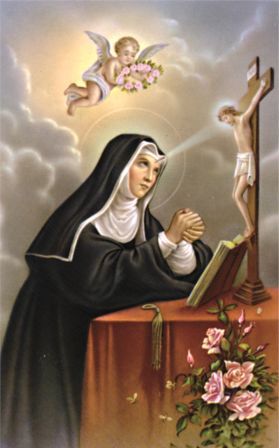
Known in Spain as “La Santa de los impossibiles” (the saint of the impossible), St. Rita has become immensely popular throughout the centuries. She is invoked by people in all situations and stations of life, since she had embraced suffering with charity and wrongs with forgiveness in the many trials she experienced in her life: as a wife, widow, a mother surviving the death of her children, and a nun.
Rita was born in the year 1381 in the village of Roccaporena, near Cascia , Italy . Her parents, Antonio and Amata Lotti, considered her birth a very special gift from God, for Rita was born to them as they were already advancing in age. As a young girl Rita frequently visited the convent of the Augustinian Nuns in Cascia and dreamed of one day joining their community. Her parents, however, had promised her in marriage, according to the custom of the day, to Paolo Mancini, a good man of strong and impetuous character. Rita accepted her parents’ decision, resolved to see this as God’s will for her.
After Rita’s husband died, she joined an Augustinian community of religious sisters, where she was known both for practicing mortification of the flesh and for the efficacy of her prayers.

At the age of thirty-six Rita pledged to follow the ancient Rule of Saint Augustine. For the next forty years she gave herself wholeheartedly to prayer and works of charity, striving especially to preserve peace and harmony among the citizens of Cascia. With a pure love she wanted more and more to be intimately joined to the redemptive suffering of Jesus, and this desire of hers was satisfied in an extraordinary way. One day when she was about sixty years of age, she was meditating before an image of Christ crucified, as she was long accustomed to doing. Suddenly a small wound appeared on her forehead, as though a thorn from the crown that encircled Christ’s head had loosed itself and penetrated her own flesh.
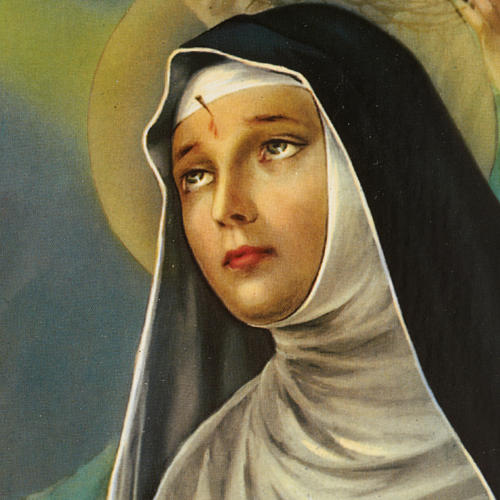
For the next fifteen years she bore this external sign of stigmatization and union with the Lord. In spite of the pain she constantly experienced, she offered herself courageously for the physical and spiritual well being of others. During the last four years of her life Rita was confined to bed and was able to eat so little that she was practically sustained on the Eucharist alone. She was, nevertheless, an inspiration to her sisters in religion and to all who came to visit her, by her patience and joyful disposition despite her great suffering.
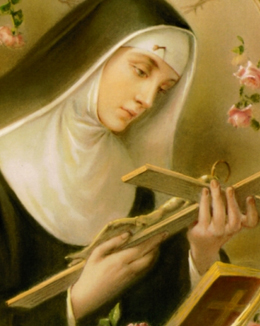
One of those who visited her some few months before her death — a relative from her hometown of Roccaporena — was privileged to witness firsthand the extraordinary things wrought by Rita’s requests. When asked whether she had any special desires, Rita asked only that a rose from the garden of her parents’ home be brought to her. It was a small favor to ask, but quite an impossible one to grant in the month of January! Nevertheless, on returning home the woman discovered, to her amazement, a single brightly-colored blossom on the bush where the nun said it would be. Picking it, she returned immediately to the monastery and presented it to Rita who gave thanks to God for this sign of love. Thus, the saint of the thorn became the saint of the rose, and she whose impossible requests were granted her became the advocate of all those whose own requests seem impossible as well. As she breathed her last, Rita’s final words to the sisters who gathered around her were, “Remain in the holy love of Jesus. Remain in obedience to the holy Roman Church. Remain in peace and fraternal charity.”
Various miracles are attributed to her intercession, and she is often portrayed with a bleeding wound on her forehead, which is understood to indicate a partial stigmata.

Pope Leo XIII canonised Rita on 24 May 1900. Her feast day is celebrated on 22nd May. At her canonisation ceremony she was bestowed the title of Patroness of Impossible Causes, while in many Catholic countries, Rita came to be known as the patroness of abused wives and heartbroken women. Her incorrupt body remains in the Basilica of Santa Rita da Cascia.

 The POSITIVE Catholic