7) Danakil Depression
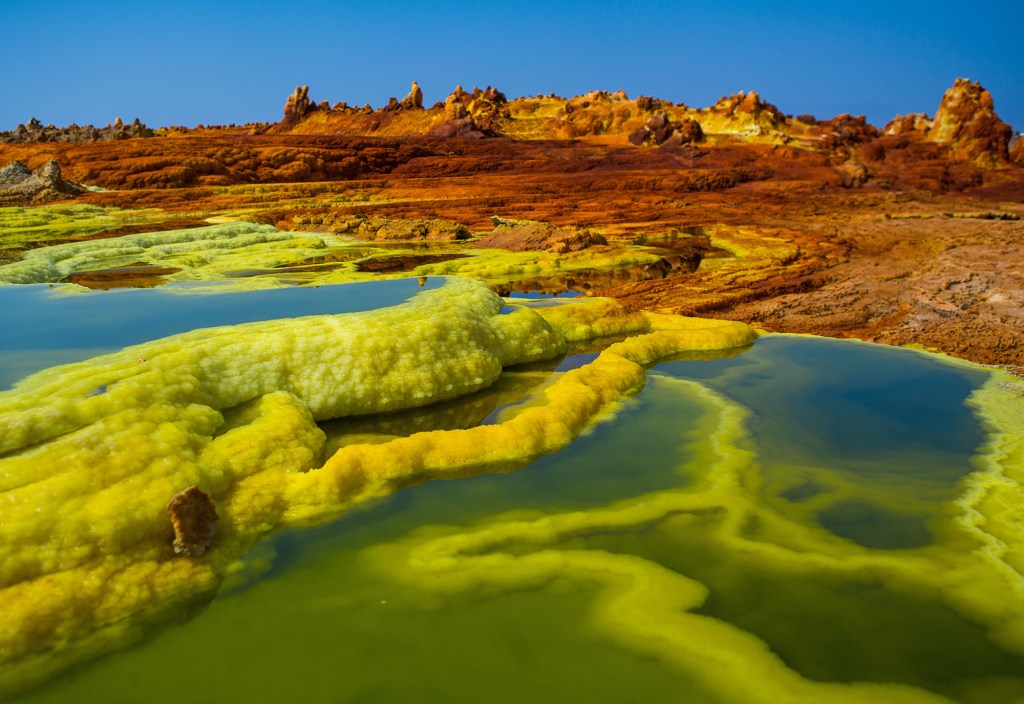
In the Afar region of northern Ethiopia, lies a vast, tortured, desert plain called the Danakil Depression. Danakil lies about 410 ft (125 m) below sea level, and is one of the hottest and most inhospitable places on Earth— temperatures average 94 degrees Fahrenheit (34.5 Celsius) but have been recorded above 122 Fahrenheit (50 Celsius). Numerous sulfur springs, volcanoes, geysers, acidic pools, vast salt pans, and colorful mineral-laden lakes dot the area, which formed above the divergence of three tectonic plates. Volcanic activity heats spring water, bringing sulfur and iron to the surface, leaving behind yellow, green, and orange deposits. For centuries, locals have been trekking in with camel caravans to mine the salt by hand, and in recent years, a few have been guiding tourists into the alien-looking landscape.
8) Arba Minch
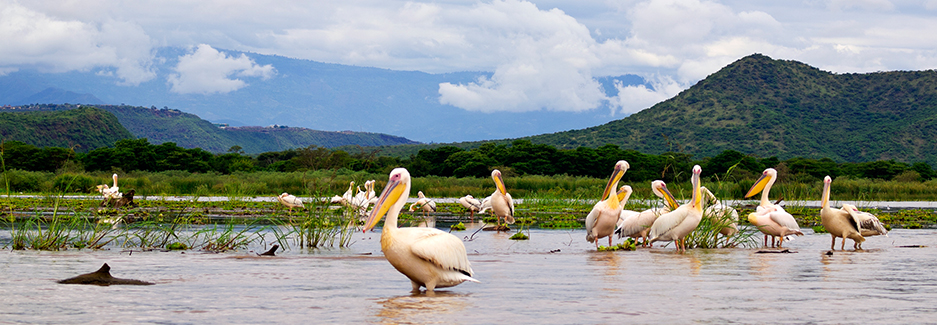
Arba Minch is more of a large town with a population of around 100,000, Arba Minch had initially replaced Chencha as the capital of what is now a disbanded province. It is mainly known for its airport – allowing for fast access to and from Addis Ababa, and on to the south – and for its university, which is home to 15,000 students.
Arba Minch is situated on the edge of Nech Sar National Park, which houses Lake Chamo and Abaya, the second biggest by surface area in Ethiopia, as well as beautiful mountain landscapes and forests, including God’s Bridge, a mountainous area of dense acacia scrub separating the two lakes.
After the collapse of the Derg in 1991, the park suffered neglect when the surrounding pastoralist tribes moved in. As a result, many of the large mammal species in the area were wiped out, including wild dog, Grevy’s zebra, cheetah, black rhino, elephant and buffalo among many others. There have been on and off attempts since to reintroduce species once found here. The current mammal species list is currently estimated at not much more than 40, more than half of which are bats, including the banana pipistrelle, Africa’s smallest species.
Despite the demise of mammals in the park, the bird life is spectacular, with up to 275 species identified including the endemic Nechisar nightjar, which was first seen alive in 2009 and the white-tailed lark, whose only home within Ethiopia is Nech Sar.

 The POSITIVE Catholic