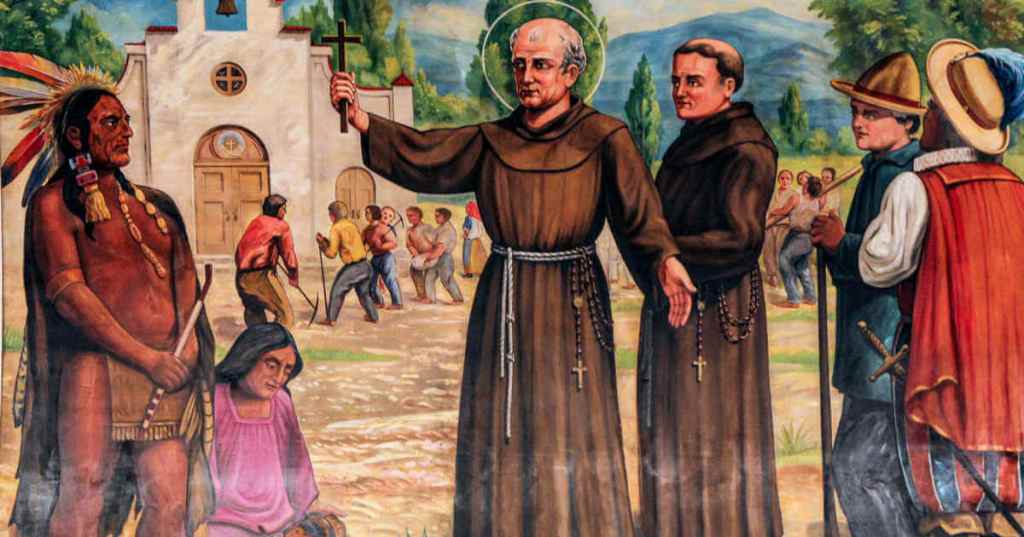
St. Junipero Serra
St. Junípero Serra was born on November 24, 1713 on the island of Majorca, Spain. He joined the Franciscans in 1730, and became so accomplished as a student that he was appointed a lector of philosophy before his ordination.
As an academic, he was promising. After earning his PhD, he began teaching eventually earning the Duns Scotus chair of philosophy. However, at 36, he gave up this career, desiring instead to be a missionary in the New World.
Padre Serra began his missionary work in Mexico. While working among the Pame Indians, he learned their language and translated the catechism for their understanding. Working in Mexico, he gained a reputation as a preacher deeply devoted to penance and mortification. He would pound his breast with a stone and even hold a lighted torch to his bare chest. He was also known for doing the work of young boys in cleaning the convent of San Fernando, where he was first assigned. Soon after his arrival in the New World, he sustained a spider bite to his leg that would leave him permanently injured. However, he was still known to walk everywhere whenever possible.
In 1767, Serra was assigned to preach in what was then called Upper California, encompassing much of the modern-day state. Here, he established several missions, for which he became famous. These missions remain today, and stretch from San Diego to San Francisco.
Padre Serra died in 1784. Many native peoples whom he had worked with wept openly at his funeral. He is at San Carlos Borromeo Mission in Carmel by the Sea. He is credited with bringing the faith to the California region.
Reflection
The word that best describes Junipero is zeal. It was a spirit that came from his deep prayer and dauntless will. “Always forward, never back” was his motto. His work bore fruit for 50 years after his death as the rest of the missions were founded in a kind of Christian communal living by the Indians. When both Mexican and American greed caused the secularization of the missions, the Chumash people went back to what they had been.

 The POSITIVE Catholic