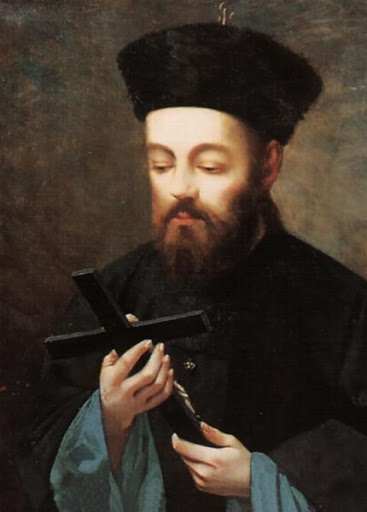
St John Gabriel Perboyre
Nothing happens by chance. Neither life, nor death, nor vocation. JOHN GABRIEL PERBOYRE was born in Montgesty, near Cahors, in southern France, on 6 January 1802 into a family which gave three missionaries of St. Vincent and two Daughters of Charity to the Church. Such an environment exuded faith, simple and healthy values, and the sense of life as gift.
The one who “calls by name” seemed to ignore him as a teenager. The call came to his younger brother Louis for entrance into the seminary. John Gabriel was asked to accompany his younger brother for a time, while waiting for him to get adjusted to the surroundings. John Gabriel’s presence at the seminary, then, happened by chance and he should have left quickly. But chance revealed to the astonished eyes of the young man unexpected horizons: that in the seminary he had found his path.
The Church of France had at that time just emerged from the throes of the French Revolution with the red-coloured garments of martyrdom for some, and with the pain of the apostasy of many. The panorama at the beginning of the 1800’s was desolate.
His parents, surprised, accepted the choice of their son and accompanied him with their encouragement. Not by chance, his paternal uncle Jacques was a missionary of St. Vincent. This explains why in 1818 the missionary ideal matured in the young John Gabriel.
John Gabriel did not think in half-measures. If he was a martyr it is because he was a saint.
From 1818 to 1835 he was a missionary in his own country. First, in his formation period, he was a model novice and student. After his priestly ordination (1826), he was charged with the formation of seminarians.
Unexpectedly in 1839 two events, apparently unrelated, clouded the horizon. The first was the renewed outbreak of persecution which flowed from the decree of the Manchurian emperor, Quinlong (1736-1795), which had proscribed the Christian religion in 1794.
The second was the outbreak of the Chinese-British War, better known as the “Opium War” (1839-1842). The closure of the Chinese frontier and the pretence of the Chinese government to require an act of dependence from the foreign ambassadors had created an explosive situation.
The missionaries, obviously interested only in the first event dealing with the persecution of Christians, were always on their guard. As often happens, too many alarms diminished the vigilance.
A series of trials began. The first was held at Kou-Ching-Hien. The replies of the martyr were heroic:
– Are you a Christian priest?
– Yes, I am a priest and I preach this religion.
– Do you wish to renounce your faith?
– No, I will never renounce the faith of Christ.
They asked him to reveal his companions in the faith and the reasons for which he had transgressed the laws of China. They wanted, in short, to make the victim the culprit. But a witness to Christ is not an informer. Therefore, he remained silent.
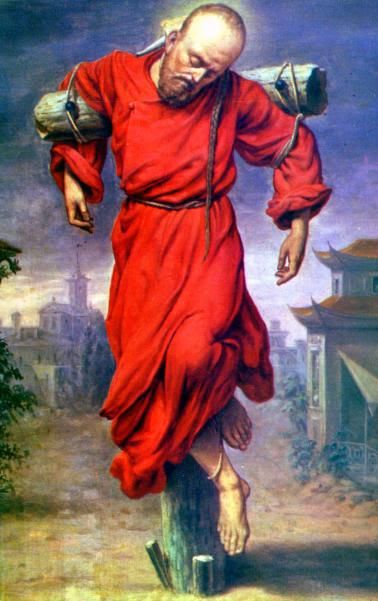
When his turn came, the executioners stripped him of the purple tunic and tied him to a post in the form of a cross. They passed a rope around his neck and strangled him. It was the sixth hour. Like Jesus, John Gabriel became like a grain of wheat. He died, or better was born into heaven, in order to make fall on the earth the dew of God’s blessing.
Many circumstances surrounding his last year of life (the betrayal, the arrest, the death on a cross, its day and hour), are similar to the Passion of Christ. In reality, all his life was that of a witness and a faithful disciple of Christ. St. Ignatius of Antioch wrote: “I look for him who died for us; I yearn for him who rose for us. Behold, the moment is near in which I will be brought forth! Have compassion on me, brothers! Do not prevent me from being born to life!”
John Gabriel “was born to life” on 11 September 1840, because he always had sought “him who died for us.” His body was brought back to France, but his heart remained in his adopted homeland, the land of China. There he gave his witness to the sons and daughters of St. Vincent who also wait to be born to heaven after a life spent for the gospel and for the poor.

 The POSITIVE Catholic